Chat Code for Bioinformatics · v0.1.0
Talk to your data.
From a one-sentence idea to a submittable manuscript draft.
cc-bioinfo combines the reasoning of large language models with a professional bioinformatics compute environment in one multi-user platform. You articulate the scientific question; the AI designs, builds the environment, codes, executes, plots and drafts — with every step logged, auditable and reproducible.
90-second overview · from question to manuscript
What is cc-bioinfo?
In form, it is a multi-user analysis environment installed on a Linux server and reached through a browser — much like RStudio Server, except you do not write the code; you talk to it. Nothing is installed on your own machine: open a browser and start. The analysis runs on the server and keeps running after you close the tab.
cc-bioinfo (Chat Code for Bioinformatics) is a multi-user, self-hosted, AI-native bioinformatics analysis platform: researchers describe an analysis intent in natural language, the platform automatically generates and executes R/Python code, and produces reproducible bioinformatics workflows and publication-ready manuscript drafts. It contains two engines: bio-design handles study design and bio-analyze handles analysis execution.
- Server: Ubuntu 24.04+ LTS. Client: any modern browser, nothing to install
- v0.1.0 released 2026-07-09 — the first production release, pairing a multi-user server architecture with the dual-engine pipeline validated on real studies
- 6 independently completed real research topics validated end to end, including honestly reported negative results
- 100+ pre-installed scientific agent skills (153 verified at v0.1.0) across 4 plugin marketplaces
- 4 instant-messaging channels (WeChat, DingTalk, Feishu, Telegram) with end-to-end tests passing
By the numbers: one of the six completed studies ran 7 parallel evidence lines over 26 hours unattended; the commonly cited figure is that 80 percent of bioinformatics time goes into getting code to run rather than analysing data, and removing that step is the platform's first job. A self-hosted deployment needs at minimum 2 CPU cores, 4 GB of memory and 10 GB of disk, with 4 cores, 8 GB of memory and 20 GB of disk recommended for departmental multi-user use; the installer runs 17 self-checks and the streaming file transfer cap is 200 MB. Individual users install nothing at all — the browser is the only client.
The personal edition is the same Linux environment, running through WSL on your own Windows machine — still reached through a browser.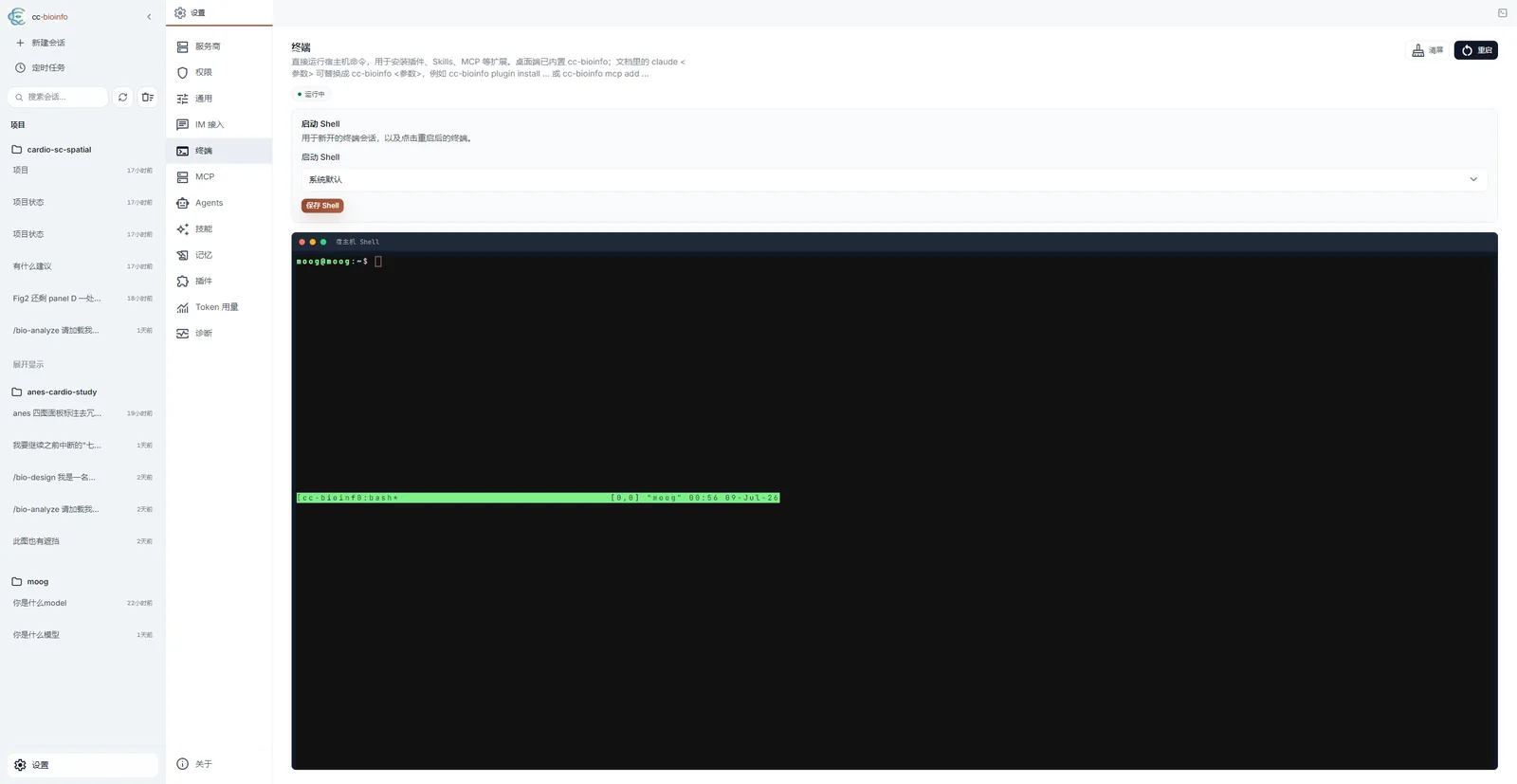
How do I get it? Personal and Enterprise editions
Try it free first, buy it only if it fits. Four channels for four different situations:
| Your situation | What to do | Notes |
|---|---|---|
| Want to see whether it works for you | Email moogtang@gmail.com to arrange a trial | No installation, no environment setup, no data needed to start |
| Personal edition (individual researcher) | Email moogtang@gmail.com for a quote | Runs on your own computer; Windows users import the image through WSL, data stays local |
| Individual users in mainland China | Order directly via Xiaohongshu (RED) | No cross-border payment needed; the account also posts real analysis pitfall write-ups |
| Enterprise edition (department, lab, institution) | Email moogtang@gmail.com for a quote | Includes self-hosted deployment, multi-user isolation, institutional account authentication and deployment support |
Both editions are quoted on enquiry; there is no public price list.
Personal edition is for
- Working on your own project, with no need for shared access
- Sensitive data that should stay entirely on your own machine
- No wish — and no need — to provision a separate server
- A machine that keeps up: 16 GB of memory works, 32 GB is safer — everything runs locally
- Setup is covered on video: personal edition setup guide
Enterprise edition is for
- Shared analysis platforms in departments, labs, hospitals and universities
- Teams that need per-member data isolation while sharing compute and model resources
- Organisations required by compliance or IT policy to host it on their own servers
The platform's product introduction and public documentation are available in the public cc-bioinfo repository (README, changelog, feature notes); deployment packages and installation support are provided after purchase.
How is cc-bioinfo different from a chatbot?
cc-bioinfo is not a chat wrapper around a large language model. It is a full-featured interactive computing environment comparable to RStudio Server plus a CWL-style workflow layer. Biologists, clinicians and data scientists talk to their data in natural language; the platform translates that intent into R or Python code, executes and debugs it inside a persistent compute environment, and produces reproducible bioinformatics workflows.
It is a server-side, multi-user platform deployed inside a lab's or hospital's own infrastructure. Researchers access it through a browser with zero local installation. Closing the browser does not interrupt anything: running analyses, scheduled jobs and IM message delivery all continue, so a run lasting 24 hours or more can finish unattended.
verified at v0.1.0
scRNA / spatial / bulk / proteomics / metabolomics / lipidomics + ATAC
files, services, configuration
nginx buffering optimized
What are the core features?
- Chat-to-code workflowDescribe the task in natural language; the system writes code, installs missing dependencies and provisions the runtime. Hand it a stack trace and it diagnoses the cause and returns corrected code.
- Zero environment setupBuilds a per-project conda environment automatically, installs missing packages on demand, and bootstraps miniconda from scratch when conda is absent — you never have to survive dependency hell.
- bio-design study designThe upstream design engine: literature decomposition plus heuristic design dialogue, backed by 382 decomposed cases and 6,235 structured decision patterns.
- bio-analyze autonomous executionThe downstream execution engine: a Step 0-7 workflow, multi-hour analyses completed unattended, all the way to an SCI manuscript draft.
- Built-in browser terminalA per-user isolated tmux terminal for shell commands, package installation and environment management — no SSH client required.
- Multi-channel IM integrationWeChat, DingTalk, Telegram and Feishu adapters all pass end-to-end tests: permission approval, project switching and streaming result cards let you decide from a phone between clinics.
- Multi-model ecosystemNatively optimized for the Claude API; unified routing to OpenAI, Gemini, DeepSeek and Ollama. Both OAuth channels supported, so no API key is required.
- Immersive IDE experienceA full browser-native Web UI: AI conversation on the left, code changes and diffs on the right; multi-project organization with session history and branching.
- Plugin ecosystemInstall community plugins from the Web UI or CLI: PubMed search, scRNA-seq QC, Open Targets, Consensus and more.
- Three-tier configurationProject tier over user-global tier over framework defaults. Lab-specific marker gene lists merge with built-in knowledge instead of replacing it.
How are multi-user architecture and data security designed?
cc-bioinfo uses a three-layer multi-user architecture: an nginx reverse proxy with Lua, a Go authentication service backed by Linux PAM with sessions and audit logging, and one isolated Bun process per user managed by systemd template units.
- Process-level isolation: each user session runs under its own Linux UID with PrivateTmp, memory limits and CPU quotas.
- Unix socket routing: requests route through a per-user socket, so users cannot reach each other's sessions — verified by a real cross-user isolation test with 2 users signed in concurrently.
- Institutional account authentication: the authentication service speaks Linux PAM directly, so researchers log in with existing institutional credentials and no separate account system is needed.
- Server-resident persistence: user processes are systemd-managed and independent of browser connections; services recover automatically after a host reboot.
On data residency, stated honestly: raw data is only read by the local R/Python environment on the server. Whether any data leaves the intranet depends on the LLM provider your administrator configures. A self-hosted LLM such as Ollama can be configured for full data residency — but the platform itself does not technically enforce it, and we say so plainly rather than implying a guarantee it cannot make.
How does cc-bioinfo compare with RStudio Server, Jupyter and chatbots?
| Capability | cc-bioinfo | RStudio Server / Jupyter | General AI chatbot |
|---|---|---|---|
| Interaction | Natural-language dialogue; code generated and executed automatically | Hand-written code | Dialogue, but advice only — cannot execute |
| Environment setup | Builds conda automatically, installs missing packages, bootstraps from scratch | You configure and maintain it | Not applicable |
| Study design | bio-design heuristic dialogue plus literature decomposition | None | No structured process; dataset IDs may be fabricated |
| Lifecycle coverage | Design to analysis to figures to SCI draft to submission package | Execution environment only | No execution environment |
| Multi-user isolation | Linux UID process isolation with PAM authentication | Yes, self-administered | Not applicable |
| Unattended runs | Server-resident; survives browser close; remote IM control | Session tied to the client | Not applicable |
| Quality governance | Pre-registration locks, data-integrity iron rules, five-dimension quality audit | Relies on user discipline | None |
Data verified 2026-08-11 against cc-bioinfo v0.1.0 documentation.
For a closer comparison — against general AI skill libraries, online analysis platforms and hand-written scripts, plus the cases where this platform is the wrong choice — see the comparison page.
Who is cc-bioinfo for, and who is it not for?
A good fit
- Clinical researchers who need to publish but do not code — the primary audience
- Graduate students and wet-lab scientists blocked by environment setup or unfamiliar with the command line
- Institutional platforms at hospitals, research institutes and universities that must share resources while keeping user data isolated
- Researchers blocked by IT policy from installing local software
- Bioinformatics engineers who want a smarter RStudio Server
Not a fit
- Production-scale sequencing-centre pipelines processing hundreds of samples daily — use Nextflow or Snakemake
- Novel algorithm and methodology development — program it directly
- Pure upstream analysis such as genome assembly and alignment — use BWA, GATK or SPAdes
- Expecting AI to replace statistical training and scientific judgment — key checkpoints still pause for a human decision
How do I get started?
- Step 1 · Arrange a trial: email moogtang@gmail.com. You then talk to it in the browser. Two good first moves: drop in a reference paper from your field for bio-design to decompose, or take a public GEO dataset and let bio-analyze run QC and clustering.
- Step 2 · Pick an edition: personal edition for individual use, enterprise edition for a department or institution. See the purchase section.
- Step 3 · Deploy and activate: for the personal edition, follow the setup guide — three videos cover the whole process. Enterprise edition deploys on your own servers — the setup wizard installs every dependency, configures TLS and runs 17 self-checks. Deployment packages and installation support are provided after purchase.
| Requirement | Enterprise (server) | Personal (your own machine) |
|---|---|---|
| Operating system | Ubuntu 24.04+ LTS | Windows + WSL2 (import the Linux image) |
| CPU | 2 cores minimum, 4+ recommended | 4 cores or more |
| Memory | 4 GB minimum, 8 GB+ recommended | 16 GB minimum, 32 GB recommended |
| Disk | 10 GB minimum, 20 GB+ recommended | 300 GB recommended |
The two columns differ widely because they measure different things. The enterprise figures cover the platform itself; the actual analysis runs on institutional compute. On the personal edition everything happens on your machine — platform, conda environments, raw data and computation — so size it for real single-cell and spatial work. The setup guide covers obtaining the image and installing it.
Frequently asked questions (FAQ)
How do cc-bioinfo, bio-design and bio-analyze relate to each other?
They are one platform plus two built-in engines, not three parallel products. In one sentence: cc-bioinfo is the stage, bio-design is the screenwriter, bio-analyze is the director and the whole cast.
| Name | Question it answers | When you use it | What you get |
|---|---|---|---|
| cc-bioinfo | Where does it run? | Throughout — it hosts the other two | Browser workbench, built-in terminal, multi-user isolation, sessions that survive closing the browser |
| bio-design | What study should I do? | Before the proposal, before you have data | design.md plan (hand it to a supervisor) plus the machine-readable TOPIC.yml contract |
| bio-analyze | How do I actually run it? | Once the design is fixed and data is in hand | Analysis results, publication figures, technical report, SCI manuscript draft |
Either engine works on its own: use bio-design alone just to think a study through, or bio-analyze alone if you already have a plan and data. Chained together they close the loop — /bio-design review maps execution outputs back onto the design and produces a revised version that feeds the analysis engine again.
How do I buy it and what editions are there?
There are two paid editions: the personal edition for individual researchers, and the enterprise edition for departments, labs and institutions, which includes self-hosted deployment and multi-user isolation. Both are quoted on enquiry with no public price list — email moogtang@gmail.com; individual users in mainland China can also purchase directly through Xiaohongshu. See the purchase section.
Do I need to know how to code to use cc-bioinfo?
No. Researchers describe the analysis intent in natural language and the platform builds the environment and generates and executes the R/Python code. However, key scientific judgments such as cell-type annotation confirmation, analysis direction and figure review remain the researcher's decision.
I cannot set up environments and do not use the command line. Can I still use it?
Yes. Environment setup is the first barrier in bioinformatics and the point where most people actually give up — the commonly cited figure is that 80 percent of bioinformatics time goes into getting code to run rather than analysing data. The platform puts the terminal in the browser, so no SSH client is needed; more commonly you never touch the terminal at all, because bio-analyze creates a per-project conda environment automatically and bootstraps miniconda from scratch when conda is absent. See the pain points Q&A.
Does my data leave our servers?
Raw data such as h5, rds, FASTQ and BAM files is only read by the local R/Python environment on the server hosting the platform. Whether any data leaves the intranet depends on the LLM provider your administrator configures. The platform supports self-hosted LLMs for full data residency, but the platform itself does not technically enforce data residency.
Can I trust AI-generated analysis results?
The platform constrains trustworthiness through engineering rather than promises: pre-registered decision rules are fixed before results are seen, iron rules forbid simulated data and fabricated statistics, a five-dimension quality audit blocks interpretation until it passes, and conclusion wording is capped at what the evidence supports. Final scientific responsibility remains with the researcher: the manuscript is a draft that needs human verification.
Which omics types does cc-bioinfo support?
Six standardized pipelines are built in: single-cell RNA-seq, spatial transcriptomics, bulk RNA-seq, proteomics, metabolomics and lipidomics. Knowledge-base coverage also includes ATAC-seq, WGCNA, Mendelian randomization and molecular dynamics quality assessment.
What server does a self-hosted deployment need?
A minimum deployment needs Ubuntu 24.04 LTS or newer, 2 CPU cores, 4 GB of memory and 10 GB of disk. For multi-user departmental use 4 cores or more, 8 GB of memory or more and 20 GB of disk or more are recommended. The setup wizard installs every dependency, configures TLS and runs 17 self-checks. Individual users need none of this — the browser is the only client.